

| NAME | |
|---|---|
| Chinese Name | 顾雍, 顧雍, Gù Yōng |
| Nickname | Long-serving Chancellor of Eastern Wu |
| Other name | Cố Ung |
| Courtesy name | 元叹, 元嘆, Yuántàn, Yuan Tan, tự Nguyên Thán |
| INFORMATION | |
| Born | 168 |
| Birth Place | Wu County, Wu Commandery (吴郡吴县; huyện Ngô, quận Ngô) |
| Died | 243 |
| Death Reason | Illness (243 AD) |
| FAMILY | |
| Children | |
| Relatives | |
| CAREER | |
| Allegiance | Eastern Wu |
| Battles |
|

Biography & Historical Record
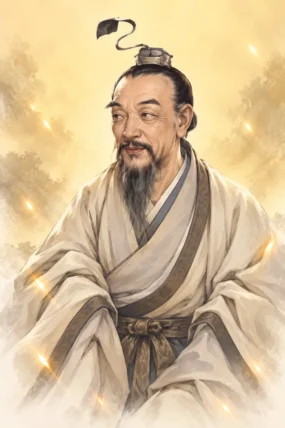
Gu Yong (顾雍, Cố Ung) (168–243 AD), courtesy name Yuan Tan (元叹, Nguyên Thán)—not to be confused with the warlord Yuan Tan (袁谭, Viên Đàm)—was the long-serving Imperial Chancellor of Eastern Wu and patriarch of the Wu Commandery Gu clan. Trained in classical scholarship (tradition links him to studies under Cai Yong), he rose through local and court offices under Sun Quan (孙权, Tôn Quyền) until he held the chancellorship for roughly nineteen years (225–243), famous for calm silence in council, careful appointments, and refusing to turn private anger into public purge.
In Romance of the Three Kingdoms he first appears among the civil voices at Chaisang who lean toward accommodation with Cao Cao (曹操, Tào Tháo) (Ch. 43), then recurs as a senior statesman in Jingzhou and Yiling debates. History remembers him less as a battlefield hero than as the administrative ballast of Sun Quan’s middle reign.
Role in Romance of the Three Kingdoms
Chapter 43 groups Gu Yong with Zhang Zhao (张昭, Trương Chiêu) and Qin Song (秦松, Tần Tùng) in the surrender-leaning civil camp until Lu Su (鲁肃, Lỗ Túc), Zhou Yu (周瑜, Chu Du), and Zhuge Liang (诸葛亮, Gia Cát Lượng) tip Sun Quan to war. Later chapters (51, 54, 84) show him as a fixed pillar of Wu court deliberation—marriage diplomacy, Jingzhou tension, and the aftermath of Yiling under Lu Xun (陆逊, Lục Tốn).
Gu Yong (顾雍) — Historical & Literary Timeline
Chaisang civil counsel
Appears among Wu scholars urging caution or peace when Cao Cao’s letter terrifies Jiangdong.
Senior court voice
Participates in deliberations on Jingzhou and Liu Bei’s marriage alliance politics.
After Yiling
Among senior officials around the debate on Lu Xun’s command and Wu’s post-Yiling settlement.
Appointed Chancellor
Historically becomes Imperial Chancellor of Wu; holds the post nearly two decades.
Death in office era
Dies after a long chancellorship; remembered for restraint and administrative stability.
See Gu Yong on Wikipedia and SGZ Wu biography.
Key Relationships
Family
- Gu Ji (顾济): Son (site custom avatar).
- Gu Rong (顾荣): Relative of the Gu clan network (site custom avatar).
- Wu Commandery Gu lineage—one of Jiangdong’s great clans.
Friends
- Sun Quan (孙权, Tôn Quyền): Lord who trusted Gu Yong with the civilian center of the state.
- Zhang Zhao (张昭, Trương Chiêu): Fellow senior civil leader of early/mid Wu.
Enemies
- Cao Cao (曹操, Tào Tháo) / later Wei: Strategic northern adversary of the state Gu Yong administered.
Other
In Novel
Chapter 43
- Gu Yong (顾雍, Cố Ung): Courtesy name Yuan Tan (元叹, Nguyên Thán); senior Wu civil figure who, with Zhang Zhao (张昭, Trương Chiêu) and Qin Song (秦松, Tần Tùng), leans toward accommodation when Cao Cao (曹操, Tào Tháo) threatens Jiangdong—until the war faction prevails.
Chapter 51
- Gu Yong (顾雍, Cố Ung): Appears as a trusted administrative voice in Sun Quan’s court during Jingzhou-related policy talks.
Chapter 54
- Gu Yong (顾雍, Cố Ung): Takes part in deliberations around Liu Bei’s (刘备, Lưu Bị) marriage alliance and the continuing Jingzhou dispute.
Chapter 84
- Gu Yong (顾雍, Cố Ung): Among senior officials associated with court debate after Yiling and Lu Xun’s (陆逊, Lục Tốn) command.
In History
Summary
- Gu Yong (顾雍, Cố Ung), courtesy Yuan Tan (元叹)—distinct from warlord Yuan Tan (袁谭)—was Eastern Wu’s long-serving Chancellor and a leading Wu Commandery aristocrat.
Year: early career
- Classical education; local offices in Wu; reputation for integrity and measured speech.
Year: 225–243 AD
- Serves as Imperial Chancellor for about nineteen years under Sun Quan; known for quiet council manners, careful personnel choices, and stabilizing civilian government while generals fought on the frontiers.
Year: 243 AD
- Dies after decades at the summit of Wu administration.
Historical Record
- Biography in Sanguozhi, Wu section (Gu Yong zhuan). Pei annotations and later histories stress his restraint—contrasting novel cameo roles with a major historical chancellorship.
COMMENTS (0)