
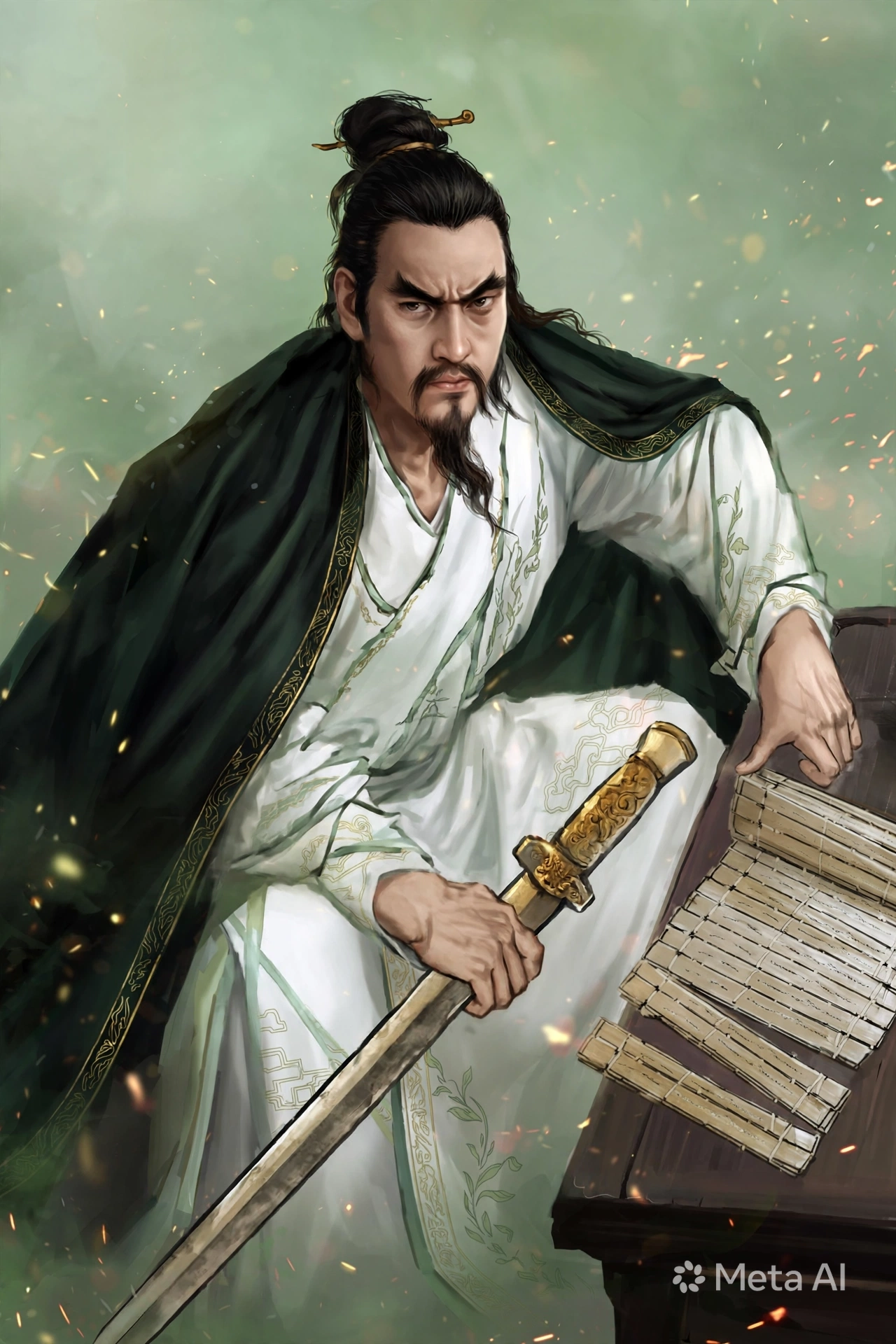
| NAME | |
|---|---|
| Chinese Name | 句践, 句踐, Jù Jiàn |
| Nickname | King of Yue (越王); "sleeping on brushwood, tasting gall" (卧薪尝胆) |
| Other name | Câu Kiến |
| INFORMATION | |
| Birth Place | Yue (modern Zhejiang region) |
| Died | 465 BC |
| Death Reason | Natural death as King of Yue (historical) |
| CAREER | |
| Allegiance | State of Yue |
| Battles |
|
Biography & Historical Record
Goujian (勾践, Câu Kiến; also written 句践), King of Yue (越王), was a ruler of the Spring and Autumn period (c. 496–465 BC) whose career became the archetype of enduring humiliation to achieve revenge. Defeated by King Fuchai of Wu, Goujian served as Wu’s vassal, famously “sleeping on brushwood and tasting gall” (卧薪尝胆) while secretly rebuilding Yue. He eventually destroyed Wu and became one of the most cited examples in Chinese political rhetoric of how a weaker state can overcome a stronger rival through patience, austerity, and popular welfare.
He is not a Three Kingdoms-era figure. Luo Guanzhong invokes him only as a historical name-drop inside Qiao Zhou’s (谯周, Kiều Chu) Treatise on Hostile States (仇国论), quoted when Jiang Wei prepares yet another northern offensive — the same rhetorical device used elsewhere for Deng Yu, Guan Zhong, and other pre-Han exemplars.
Role in Romance of the Three Kingdoms
Chapter 112 (Yu Quan Dies for Shou Chun; Jiang Wei Battles at the Great Wall): As Jiang Wei (姜维, Khương Duy) mobilizes for another Wei invasion, the scholar Qiao Zhou laments court decadence under eunuch Huang Hao and writes the 仇国论. The embedded essay cites Goujian alongside King Wen of Zhou: “Zhou Wen nourished the people, taking the many from the few; Goujian cared for the masses, using the weak to destroy the strong” (周文养民,以少取多;句践恤众,以弱毙强) — arguing that timely restraint and popular welfare, not endless warfare, are how smaller states prevail. Jiang Wei reads it, calls it “the talk of a pedant,” throws the scroll down, and marches north anyway.
Goujian (勾践) — Historical & Literary Timeline
c. 496 BC
Defeat by Wu
Goujian’s Yue is conquered by King Fuchai of Wu; Goujian endures vassalage and personal humiliation rather than reckless rebellion.
c. 473 BC
Destruction of Wu
After years of austerity and reform, Yue destroys Wu — the historical climax behind the “weak overcoming strong” trope.
Chapter 112
Cited in Qiao Zhou’s essay
Named in the Treatise on Hostile States as a model of caring for the people while biding time — contrasted with Jiang Wei’s eagerness to attack Wei.
Chapter 112 (same arc)
Rejected by Jiang Wei
Jiang Wei dismisses Qiao Zhou’s counsel and launches the Great Wall campaign that ends when Sima Zhao’s victory at Shouchun forces a Shu withdrawal.
For detailed historical records, archives, and official chronicles, explore Goujian on Wikipedia.
Key Relationships
Family
- Father Allow Chang (允常), ruler of Yue.
- Advisors Fan Li (范蠡) and Wen Zhong (文种): chief strategists of Yue’s restoration (historical; not named in ROTK passage).
Friends
- King Wen of Zhou (周文王): Paired with Goujian in Qiao Zhou’s argument as rulers who won through nurturing the people.
Enemies
- King Fuchai of Wu (吴王夫差): Historical conqueror whom Goujian ultimately overthrew.
Other
- Qiao Zhou (谯周, Kiều Chu): Quotes Goujian in Chapter 112 to warn against Shu militarism.
- Jiang Wei (姜维, Khương Duy): Rejects the essay and proceeds with the northern campaign.
- Fan Li (范蠡) and Xi Shi (西施): Associated with Goujian’s historical stratagem against Wu — outside the novel text but part of his cultural legend.
In Novel
Chapter 112
- Goujian (勾践 / 句践, Câu Kiến): Historical name-drop only — cited in Qiao Zhou's Treatise on Hostile States (仇国论): "Zhou Wen nourished the people, taking the many from the few; Goujian cared for the masses, using the weak to destroy the strong" (周文养民,以少取多;句践恤众,以弱毙强). Jiang Wei reads the essay and angrily rejects it.
In History
Summary
- Goujian (勾践, Câu Kiến), King of Yue, reigned c. 496–465 BC. After subjugation by Wu he rebuilt Yue through austerity and reform, then destroyed Wu — a foundational story of perseverance in Chinese historiography.
Year: c. 496–494 BC
- Defeated at the Battle of Fujiao; submits to Wu and serves as a vassal king.
Year: c. 473 BC
- Conquers and destroys the state of Wu.
Historical Record
- Shiji, Annals of Goujian (越王勾践世家).
- Wu Yue Chun Qiu (吴越春秋) — expanded narrative of his rise and revenge.
- Novel appearance: Chapter 112 quotation in Qiao Zhou's essay (adapted from the historical 仇国论 attributed to Qiao Zhou in Sanguozhi Shu 12).
COMMENTS (0)